


Webinar - Thursday 28 May
En økonomi bygget på gæld — Er der en vej ud?
Den globale gæld har netop nået et historisk rekordniveau på 348,3 billioner dollar [1] — mere end tre gange verdensøkonomiens størrelse. Boliglån, forbrugerlån, virksomhedsgæld og offentlige underskud vokser fortsat med en ekstraordinær hastighed. Hvorfor?
Der findes en forklaring, som sjældent drøftes i den offentlige debat. I dagens system skabes penge i sig selv som gæld. Det betyder, at pengemængden kun kan vokse, når gælden vokser. Er der en vej ud af det stadigt voksende gældsbjerg?
Sammen med 23 partner organizations har vi inviteret den tidligere økonom fra IMF og Bank of England, Dr. Michael Kumhof. Han forklarer, hvordan det nuværende system fremmer overgældsætning, ulighed og finanskriser — og præsenterer et troværdigt og realistisk alternativ: gældfri penge.
Seminaret har allerede fundet sted, men tilmeld dig nu for at se optagelsen bagefter:
* Ved at klikke på knappen giver du samtykke til, at Gode Peng & IMMR sender dig yderligere oplysninger om kommende webinarer via e-mail. Du kan til enhver tid afmelde vores e-mails ved at klikke på »Afmeld«.
Hvorfor så stor en gæld?
Som Dr. Kumhof forklarer, skabes næsten alle penge i dag af private banker, når de yder lån. [2] Vi låner hele pengemængden og betaler renter til de private banker for, at pengene overhovedet kan eksistere.
Hvad er problemet med det? I mange årtier er pengemængden – og dermed vores gæld – vokset 2–3 gange hurtigere end BNP.
Med andre ord vokser vores gæld hurtigere end vores indtægter. Det er som at forsøge at bestige et bjerg, der bliver højere hurtigere, end man kan nå at bestige det.
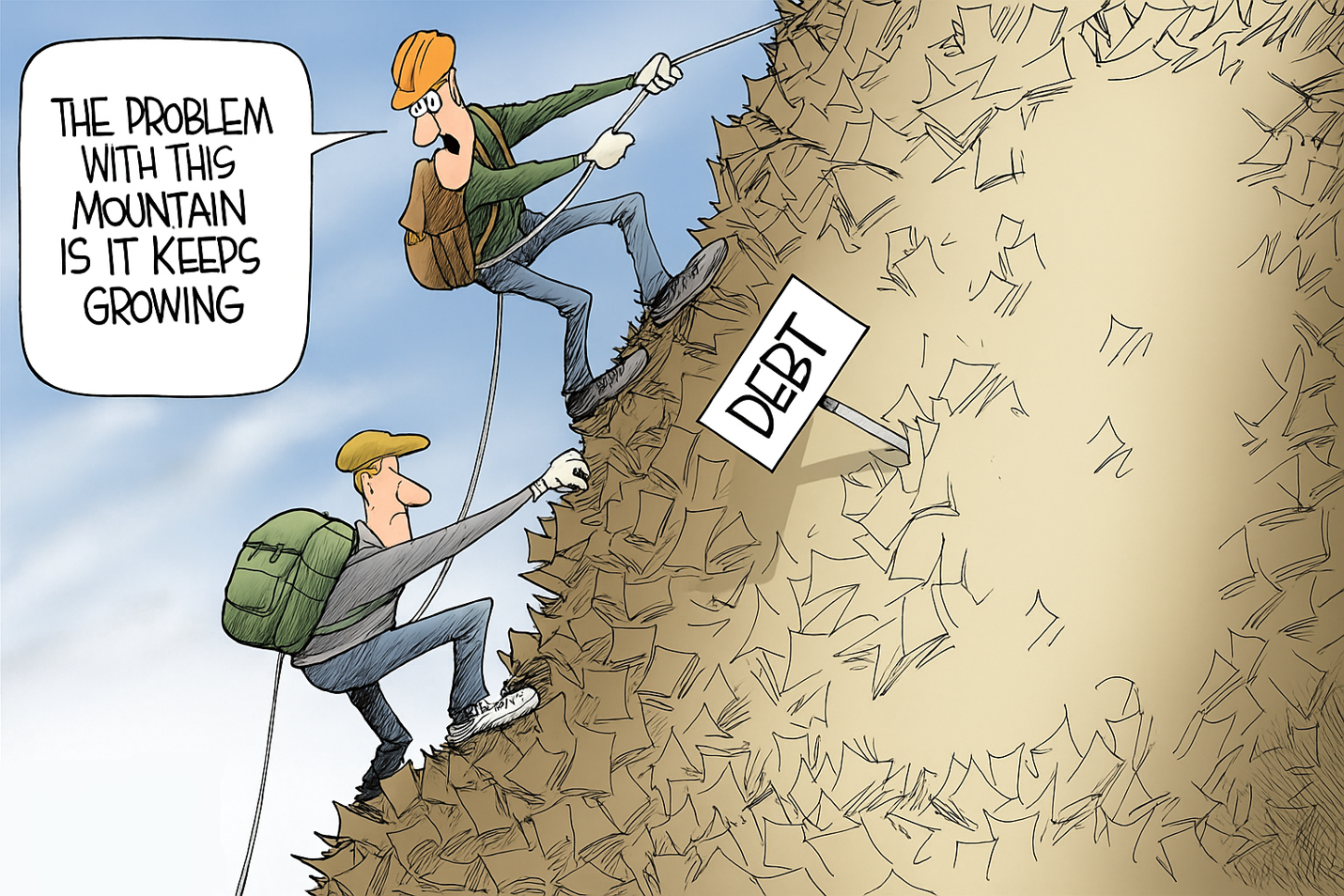
Før eller senere vil gældsbjerget blive for stort, hvilket vil føre til endnu en finanskrise. På det tidspunkt vil regeringen blive tvunget til at redde bankerne – ellers risikerer pengemængden at bryde sammen, og betalingsdygtigheden vil blive udslettet.
Webinaret er for dig, der:
- frustreret over stigende gæld og inflation;
- interesseret i økonomisk bæredygtighed, ægte demokrati og geopolitisk fred;
- bekymret over boligpriserne, ulighed, miljøforringelser og offentlig politik;
- åben over for seriøse alternativer, der rækker ud over den traditionelle venstre-højre-debat;
Der kræves ingen faglig baggrund. Webinaret henvender sig til et bredt publikum, samtidig med at det forholder sig seriøst til et af vor tids vigtigste økonomiske spørgsmål.
Hvad du kommer til at lære
- Sådan fungerer nutidens gældsbaserede penge
- Hvordan gældsbaserede penge skaber ulighed og finanskriser
- Hvorfor penge ikke behøver at være gæld
- Hvordan gældsfrie penge kan øge ligheden, fjerne finanskriser og bidrage til, at vores økonomier kan trives på en bæredygtig måde.

Se de første 5 minutter af webinaret her:
About Michael Kumhof
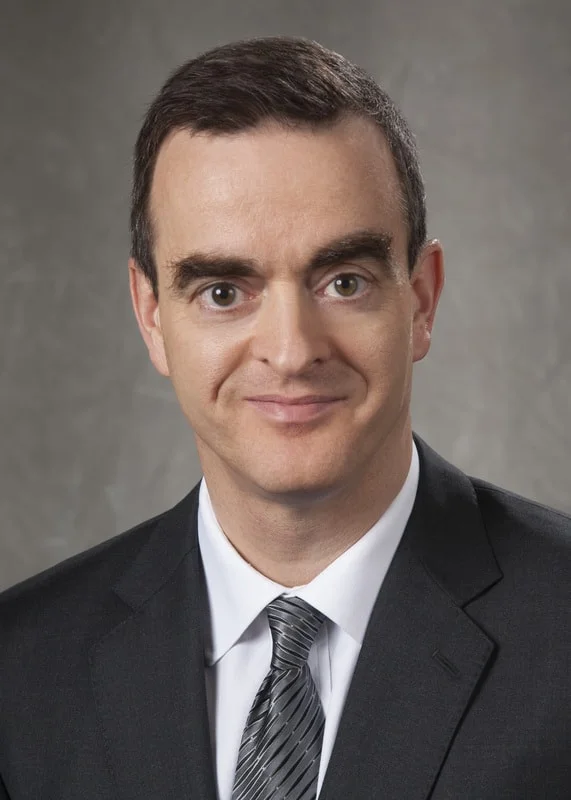
Dr. Michael Kumhof has worked at both the IMF and the Bank of England and is an internationally recognized economist specializing in banking, debt, and monetary systems. He is a former professor at Stanford University, and his research is utilized by central banks and international institutions around the world.
Some of his most important publications:
Read More
What is wrong with debt-money?
A market economy needs money to mediate members' exchange of goods and services. With a debt-based money system, the society must continuously take on new debt as prior interest-bearing debt is paid off in order to have a sufficient supply of money. And the money supply and economy can only expand if more loans are made than are paid off. This results in an ever-rising mountain of debt in booms and a shortage of money in busts when people stop borrowing. The system is inherently fragile, unjust, and unsustainable.
- Excessive debt levels make the economy highly vulnerable; even small shocks or modest interest-rate changes can trigger a financial crisis.
- Debt-money produces boom-bust cycles with an abundance of money in booms, and a shortage of money in busts, which creates unnecessary unemployment.
But the problem goes even deeper. The money in our bank accounts is itself a bank liability — a promise by banks to provide cash on demand. Yet this is a promise most banks could not fulfill. If more than a small percentage of customers tried to withdraw their money at the same time, the result would be disaster.
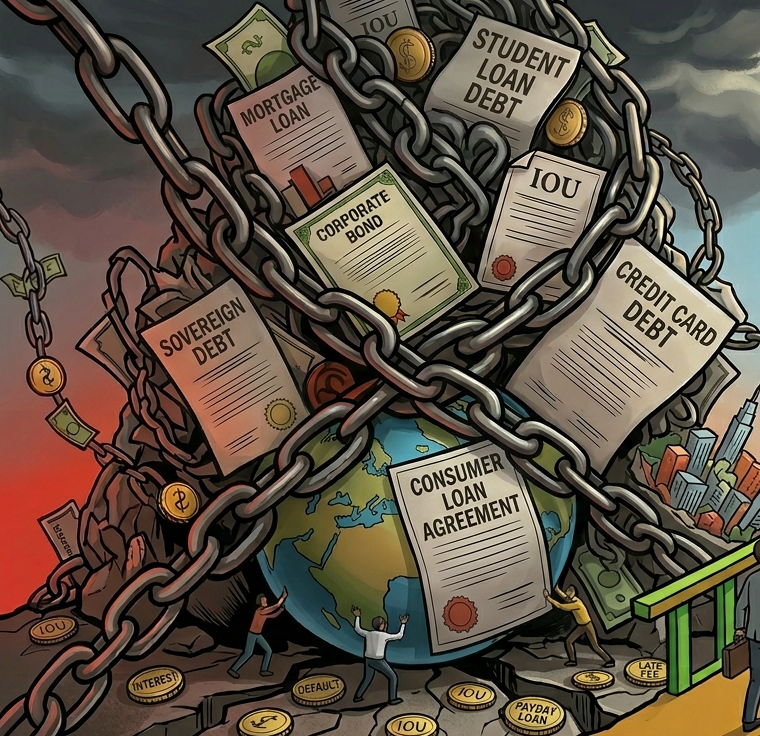
The result is excessive profits for the banks and widening economic disparities. At the same time, we are plagued by recurring financial crises and unnecessary unemployment.
History: How did we end up here?
To understand today’s system, we need to look at history. For a long time, societies used stamped precious metals as money. But metals were scarce, which often limited the money supply and constrained economic growth.
From the mid-17th century (notably 1661 with Stockholms Banco), private banks began issuing circulating paper banknotes redeemable in gold or silver. These notes were far more practical than metal coins, and banks soon discovered they could issue more notes than they held in metal, because not everyone redeemed them at once.
This made payments easier for the public, but banks still had to settle with each other in gold. That was costly and inefficient. The solution was clearing: if banks owed each other similar amounts, only the net difference had to be paid in metal.
Later, central banks became the banks of the banks. Commercial banks could hold their gold there and settle by transferring claims on reserves instead of physically moving metal. This was an efficient system for a world in which gold was scarce and settlement was cumbersome.
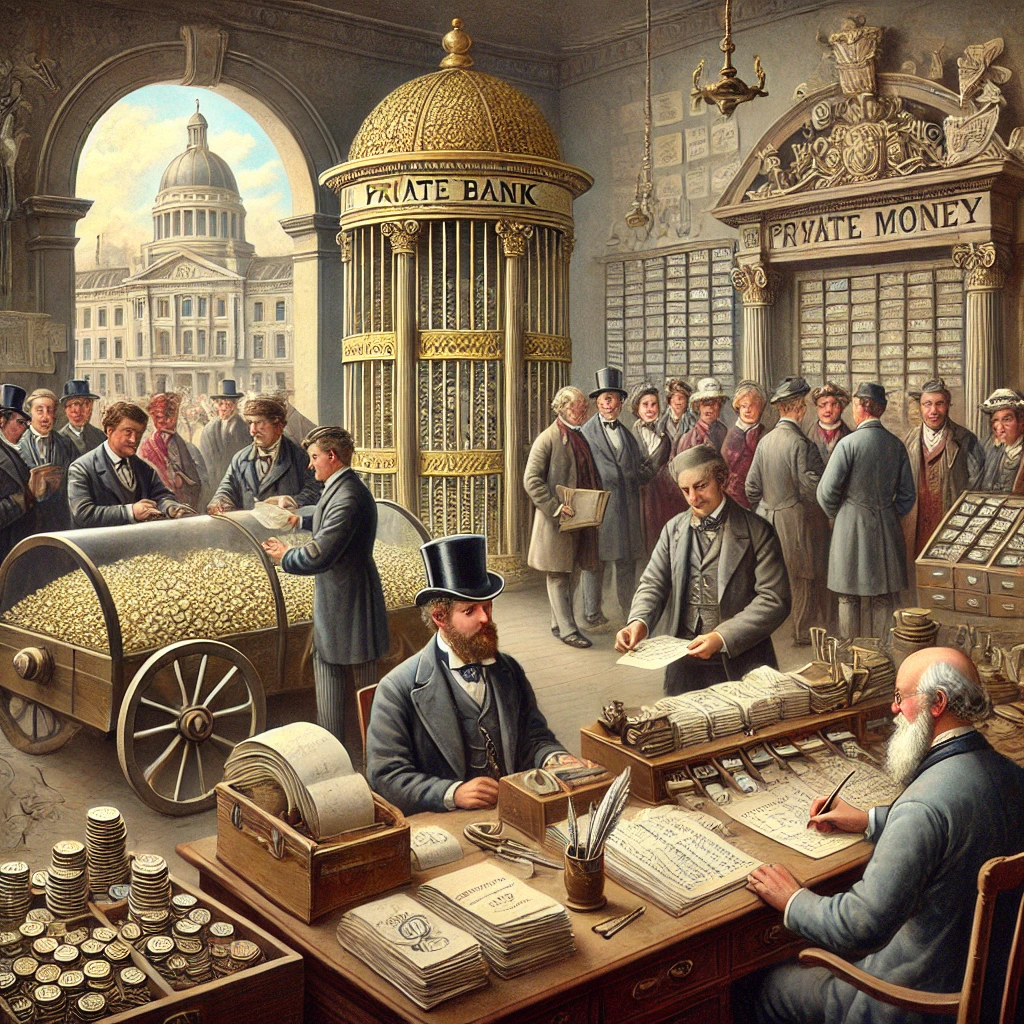
But today, almost all money is digital. We no longer live in a gold-based economy. The old debt-based chain — where bank money is a debt on central bank reserves, and central bank reserves a debt on gold — was a practical solution for another age, not a necessity for ours.
Does money really have to be debt?
Today, most money is digital. We no longer live in a gold-based economy. Central bank reserves are no longer redeemable for gold or anything outside the system. They are digital entries in their own right.
That means the monetary system could now be much simpler. We could use debt-free public digital money, issued directly by the central bank or the government, as a means of payment.
But instead we still behave as if central bank money were a a debt on a scarce resource that must be economized, and as if society must keep borrowing from private banks in order to maintain or expand the money supply.

That made sense in a world of gold, vaults, and physical settlement. In a digital fiat-money economy, it does not. This is one of Michael Kumhof’s key insights: The debt-money system is not a law of nature. It is a historical leftover — and one we no longer need.
A way out: Money without debt?
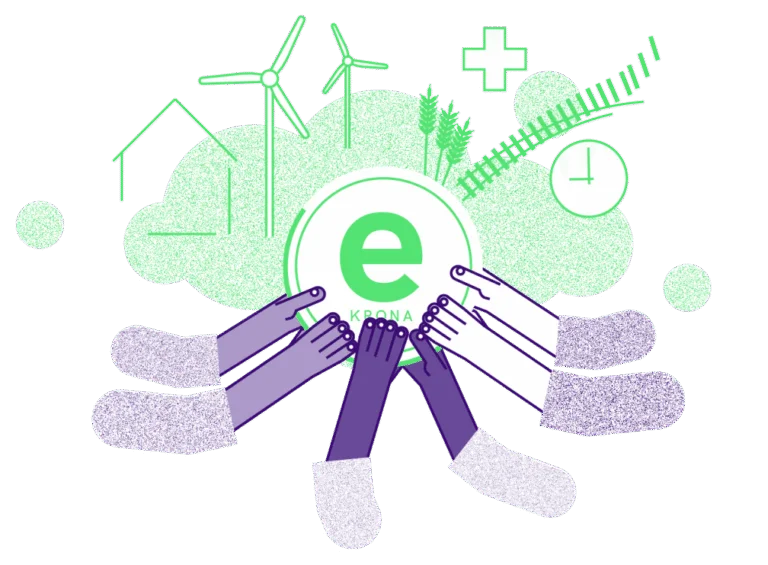
Once we separate money creation from private bank lending, a much simpler principle comes into view: Money can be created as money — not only as debt.
This means the economy would no longer need to rely on continual borrowing just to function. The money supply could remain stable or grow without forcing households, businesses, and the public sector deeper into debt.
That is a profound shift — and it opens the door to a very different kind of economic system with effects such as:
Dr. Michael Kumhof will explain why money does not have to be debt, how the current system and its accounting can be rethought — and what a realistic path beyond the debt-based system could look like.
Urgent need for action
Across the world, more and more people feel that something is deeply wrong with the economic system. Many see:
- extreme wealth disparities
- rising household debt
- housing markets detached from ordinary incomes
- recurring financial instability
- money in politics defying democracy
- a lack of money for public investements
- public dependence on oversized banks
- a political system that seems unable to direct finance toward long-term social needs
For too long, the public has been told that the current monetary system is simply how modern economies work. That is not good enough.
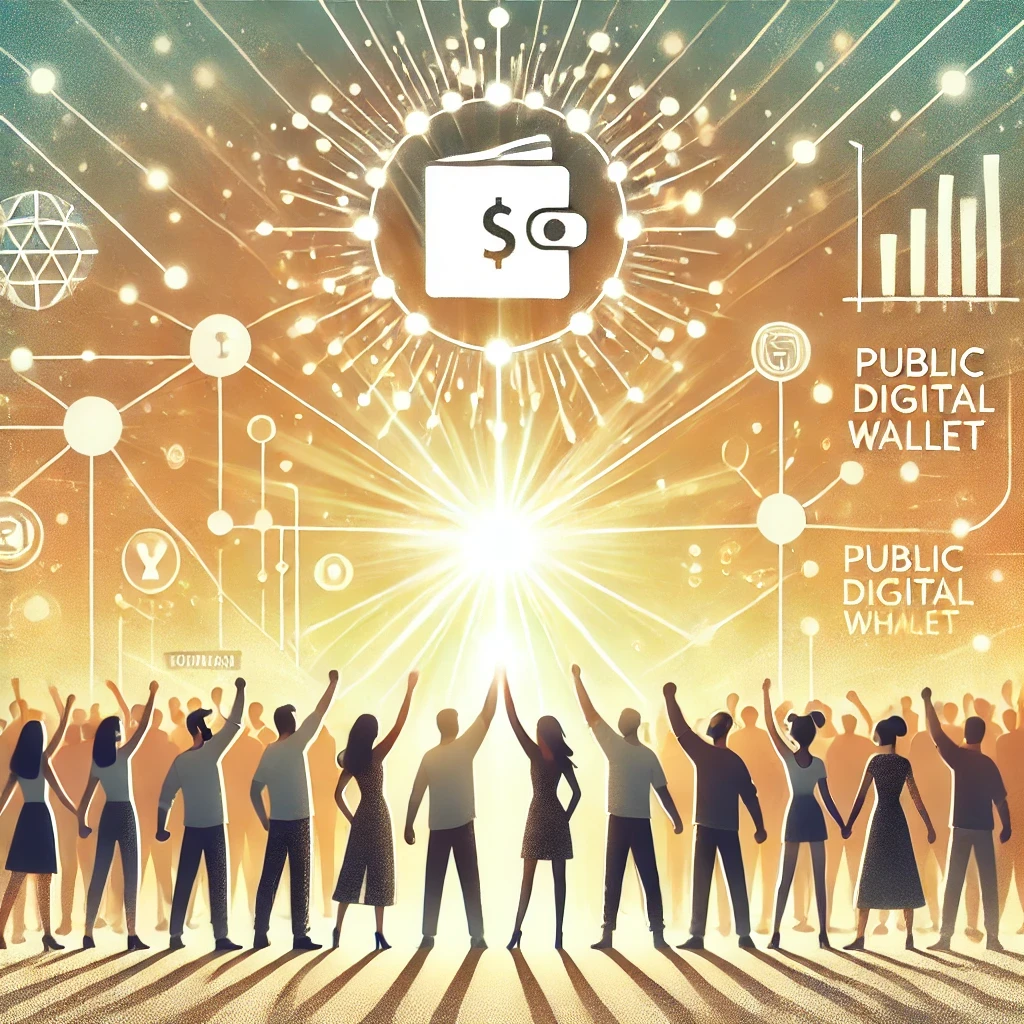
A monetary system is a human institution. It can be redesigned. It can be modernized. And it can be built so that money no longer depends on ever-rising private debt. Join Michael Kumhof for a webinar on one of the deepest structural problems in the modern economy — and learn about one of the clearest paths beyond it.
About Michael Kumhof
Dr. Michael Kumhof recently worked as Senior Research Advisor in the Research Hub of the Bank of England. Before that, he was Deputy Division Chief at the Modeling Division in the Research Department at the International Monetary Fund (IMF) (2004 to 2015). Kumhof was responsible for developing the Global Integrated Monetary and Fiscal Model of the IMF which is used at several central banks, for IMF policy and scenario analyses, for the World Economic Outlook, and for G20 work. Before that, he was Assistant Professor at Stanford University (1998 to 2004). His research focuses on the role of banks in the economy and on different monetary systems.
Recent work
Dr. Michael Kumhof has published several influential papers that analyze the monetary system in depth. Here are some of his most important works:
- Michael Kumhof published “The Chicago Plan Revisited” in 2012 as an IMF Working Paper, and a much-improved “The Chicago Plan Revisited – Debt-free Money, Growth, and Stability” in 2024. The paper finds that a transition to universal narrow banking, where all deposits consist of public money while all lending is performed by mutual funds that intermediate public money, could permanently raise US GDP by between 15% and 20%. The mechanism is a replacement of debt-based private money with debt-free public money that reduces debt and leverage and therefore interest rates throughout the economy. The paper also found that a countercyclical policy rule for the interest rate on central bank credit to banks could substantially improve the central bank’s ability to stabilise the business cycle.
- The Chicago Plan paper was the direct inspiration for the 2016 Bank of England Staff Working Paper “The Macroeconomics of Central Bank Digital Currencies” (published version from 2022). This was the paper that first coined the acronym “CBDC”.
- “Central Bank Money: Liability, Asset or Equity of the Nation?” explores a key aspect of both CBDC and the Chicago Plan, which is that the conventional practice of classifying central bank money as a liability of the consolidated public sector is irreconcilable with the legal underpinnings of modern fiat money systems. Instead, it should be classified as a sui generis hybrid category that reflects both its function as a public good and its proximity to corporate equity in several legal dimensions, including non-defaultability.
Organizers














References
[1] https://www.hurriyetdailynews.com/global-debt-hits-record-high-of-348-trillion-in-2025-report-219339
[2] Michael McLeay, Amar Radla and Ryland Thomas, “Money creation in the modern economy”, Bank of England Quarterly Bulletin Q1 (2014): 14–27;
Zoltan Jakab and Michael Kumhof, “Banks are not intermediaries of loanable funds – and why this matters”, Bank of England working paper No. 529, May 2015;
Historic opportunity
Central bankers, academics, monetary reformers, and policymakers around the world are currently discussing the problems and risks of the current monetary system and exploring new approaches to creating money. Citizens have a historic opportunity to influence and ensure that money creation is organised in a fair and sustainable way. That's why we are organizing courses and seminars on the subject. Sign up and feel free to invite friends and acquaintances.
❝
Never doubt that a small group of caring, committed citizens can change the world. In fact, it is the only thing that ever has.
Margaret Mead
The International Movement for Monetary Reform (IMMR) consists of non-profit organizations that focus on the most critical issue of our time - the creation and disappearance of money and its consequences for the development of society and our lives.
We are non-partisan and act only for this issue. Our vision is that the money system should be fair, sustainable, democratic, and used for the benefit of society as a whole. Read about IMMR here. Join our movement here.

© 2026 International Movement for Monetary Reform